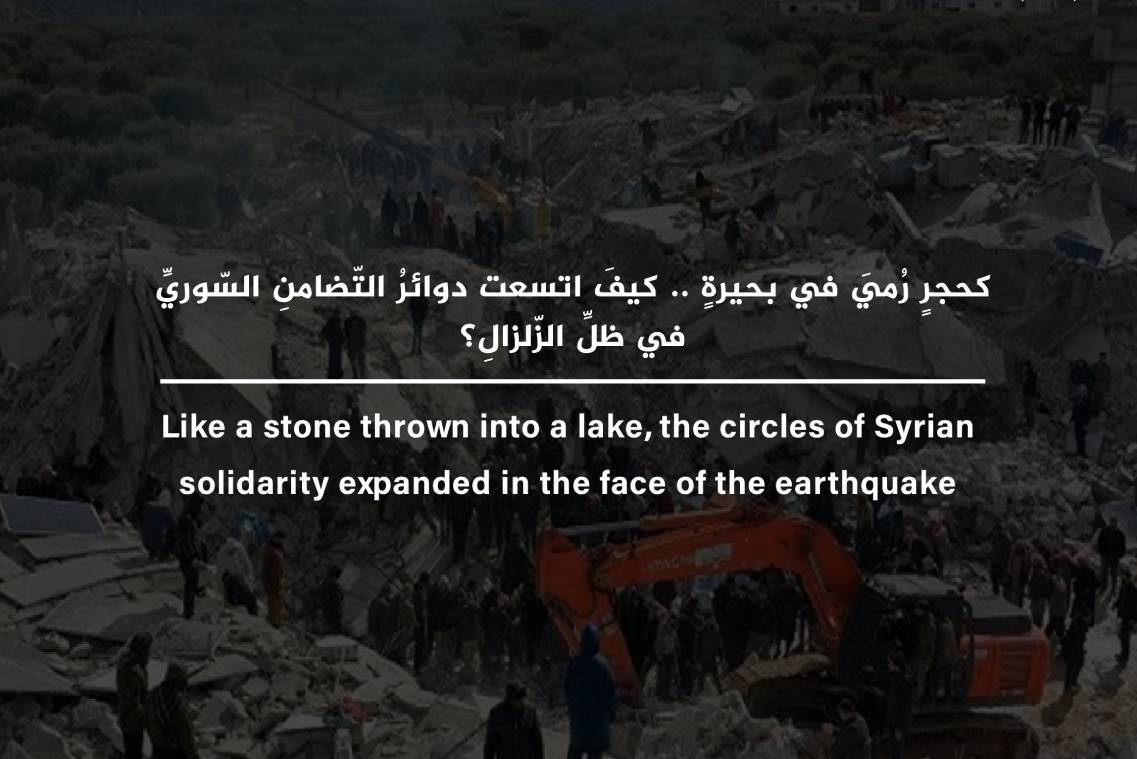
"We awoke to the ground shaking beneath us, and the pressing question on my mind was whether I was in a dream. As we stepped out onto the street, the air was filled with screams and chants from the people. The faces of the children were pale with fear as houses crumbled before our very eyes. The sound emanating from deep within the earth silenced all noise. My city, which had already suffered under the Syrian regime and was filled with martyrs, was destroyed by war. Now, it was not spared from the devastation of the earthquake," recounted Abdul Latif, a civil activist from Aleppo and a member of the Peacebuilding Club. This was the catastrophic scene that unfolded in northwest Syria after 12 long years of war and the devastating earthquake that struck southern Turkey and northwest Syria on February 6, 2023, amplifying the destruction.
However, amidst the dark and devastating aftermath of the earthquake, a glimmer of hope emerged in the form of Syrian cooperation and solidarity. Abdul Latif recounts, "In the early morning, a collective effort was formed between money transfer and trading companies, quarry and machinery owners. Expatriates from my city in Turkey and Europe were contacted to collect donations. Tasks were delegated among those present. Some dispatched machinery to aid civil defense forces in rubble removal, others collaborated with hospitals and ambulances, while others helped those whose homes were damaged to reach tents that were purchased through donations and erected in safe areas for shelter. Additionally, some were responsible for aid and food distribution. Regardless of their differences, everyone worked hand in hand tirelessly to save the people of their city in a display of true cooperation and solidarity."
Collaboration in the Face of the Earthquake
The earthquake not only brought destruction but also revealed a bright side of cooperation and solidarity among Syrians, extending beyond just one city. Imran, a civil activist from Aleppo and a member of the Peacebuilding Club, recounts how a group of people in Azaz took the initiative to secure tents for those displaced by the earthquake. They prioritized shelter for children and women and collected donations from expatriates in Europe and the Gulf, as well as from the people of Deir ez-Zor Province. As the need for tents increased, the people of Al-Fuariya stepped in to collect money to rent a larger area of land. An individual even contacted organizations to provide tents. Through this cooperation, an area of land covering about four acres was rented in Azaz, and work began on serving the camp by opening roads, building new tents, and obtaining a license from the local authorities to shelter more than one hundred families. Humanitarian assistance, medical services, and a medical point were also provided to those in need.
People stand by each other
As heart-wrenching images of children left without families circulated, institutions and individuals, including artists and athletes, answered the call to sponsor them. Skina, a civil activist from Aleppo and a member of the Peacebuilding Club, recounts a painful encounter with a father and his three daughters who lost their mother in the earthquake. The oldest daughter was six years old, the middle child was five, and the youngest was only six months old. Skina felt a sense of helplessness as she held the baby, unable to offer any assistance. However, her colleague later informed her that a wealthy person had sponsored the child. Despite the crises and wars that Syria has faced, Skina believes that this incident is both painful and hopeful, showing that the goodness in the hearts of people of good will not dry up.
The sense of responsibility towards others
The earthquake's impact was like a stone thrown into a lake, with ripples of response widening to encompass everyone from the disaster's epicenter to the least affected areas and all the way to the periphery. The poor were no less united than the better-off, as families displaced by war welcomed those displaced by the earthquake and shared what little they had in deprived camps lacking basic necessities. This catastrophe not only fostered love and solidarity among people but also revived the sense of responsibility towards others.
Zelal, a civil activist from rural Idlib and a member of the Peacebuilding Club, recounts her experience of distributing aid to survivors in the Salqin area. She came across a tent where the owner directed them to another tent saying, "I received a bag of fuel for heating today, look for someone else who might not have received anything yet." This sense of responsibility was also shared by communities across Syria, with the poor in various provinces sending whatever aid they could from their own homes, including clothes, blankets, and food. Rana, a civil activist from Suwaida and a member of the Peacebuilding Club, recalls, "The aid we received from poor families in the province was their own livelihood, from their blankets and clothes. One mother recounted how her child left a note in his jacket pocket saying, 'I'm sending you my favorite jacket, and I'll send you my shoes once I finish school.'"
Geography-transcending cooperation
The Syrian civil society organizations’ response to the disaster inside Syria demonstrated its effectiveness and capacity to carry out its duties, as evidenced by the launch of various organizations emergency relief campaigns to provide humanitarian aid to those affected. They organized and collected funds and basic necessities such as medicine, clothing, blankets, and food, and sent them to the affected areas. Medical and relief teams were also dispatched to the disaster areas. Local initiatives played a critical role in responding to the disaster and supporting basic needs, despite limited resources. With news circulating that aid was being hindered and stolen by security forces, civil society groups, teams, and organizations worked to find secure ways to ensure that aid reached the affected areas.
Lena, a civil activist from Daraa, explains that when the aid convoy she was a part of was stopped at a security checkpoint on the outskirts of Damascus, they were told to turn back, as the authorities would take care of delivering the aid. However, they refused and returned with a plan to ensure the aid reached those in need. Likewise, in Sweida, one of the civil activists reports, "We made many contacts to ensure the delivery of aid, and to ensure its success, we sent a civil team with the convoy to personally deliver aid to affected people."
In addition to relief initiatives, a volunteer initiative was launched by young women and men across Syria to create a database of earthquake victims who were missing or survived in different affected areas. Nadia, a civil activist from Suweida, explains, "This data was collected from various sources, including published hospital lists, those working on the ground, and the reports received from families and relatives of the victims through a survey published on the platform or via social media channels. The data was processed to present the information in a better way and verify its accuracy to facilitate the search process."
Humanity unites us
The earthquake that struck Syria shattered the political divisions that had been in place since 2011, as the sense of unity among the Syrian people during this catastrophe transcended any political framework. Relief efforts and messages of support poured in from all corners of Syria, with campaigns from various cities directed towards the affected areas.
Raghad, a civil activist from Qamishli and member of the Peace Building Club, notes that the earthquake had a unifying effect on Syrians, saying, "For the first time, I did not hear any discrimination or categorization of each other as (pro-regime, anti-regime, or separatist), as everyone is affected." Young people from different parts of Syria, including those from areas controlled by different factions, reached out to inquire about how they could help those affected.
The material donations collected by people in northeast Syria were given from the heart, without concern about where they would end up, whether it be north or south, to Jindires or to Idlib. As long as they helped a Syrian in need, that was all that mattered.
Raghad reflects that her perspective on the possibility of ending the conflict among Syrians was transformed by the response to the disaster: "After years of war, I had lost hope that we could come together as Syrians, but the response I witnessed from young people in particular during the disaster gave me hope and showed me a glimmer of light in this dark tunnel. I received a call from Toul, a 22-year-old from Damascus, asking how to deliver donations to people in the north and help with rescue operations. She said, 'My heart is burning, and we cannot stand idly by. How can we reach Idlib?' Toul was just one example of many young men and women who did not sit back and watch, but instead wiped their tears with one hand and helped with the other. Like many young Syrians, Raghad dreams of a united Syria where we can move freely from Damascus to Idlib to Afrin to Qamishli, without borders or barriers hindering us, and without factions interrogating us, because this geography is ours and belongs to us."
The severity of the disaster brought out a deeper sense of belonging among the Syrian people, a connection to their shared humanity. They showed that cooperation and joint action among individuals can transcend biases towards beliefs and ideas, and narrow identities. They opened themselves to the human dimension of societies, proving that the earthquake that hit Turkey and northern Syria on February 6 confirmed a number of truths that many Syrians had thought were erased by the war. Numerous stories were witnessed, experienced, and heard that reflect these divine words: "Whosoever saves a life, it is as if he has saved all mankind."
Submitted by:
Saraa Al-Hussein
Raghad Al-Motlak
Proofreader:
Oubaida Al-shikh deb